Last updated October 15, 2026
ADU Cost Breakdown: The Dallas Homeowner’s Reference for 2026
The most expensive line item in a Dallas ADU isn’t framing, roofing, or even the kitchenette. It’s the utility service extension. Running power, water, and sometimes gas from your main house to a detached accessory dwelling unit can cost between $8,000 and $25,000 depending on distance, and most contractor quotes conveniently leave that line item out. This guide covers the real 2026 numbers for Dallas, the line items most estimates bury until they become change orders, and how to read a bid so you’re not surprised when the final invoice arrives. For a deeper dive, see our The Complete Guide to ADU in Dallas.
Quick Answer
A detached ADU in Dallas will cost roughly $180 to $340 per square foot in 2026, meaning a typical 600-square-foot unit runs $108,000 to $204,000 all-in with permits, utilities, and site work. A garage conversion costs $80 to $160 per square foot because the shell already exists, while an attached room addition typically lands between $150 and $250 per square foot. These are Dallas numbers based on local labor rates, Dallas Development Services permit fees, and the soil conditions that affect foundation work in this region.
Table of Contents
- The Three ADU Types and What They Actually Cost in Dallas
- Per-Square-Foot Ranges: Low, Mid, and High-End Explained
- Dallas Permit and Inspection Fees, Itemized
- The Utility Connection Costs Most Quotes Leave Out
- Hidden Cost Categories That Inflate Final Bills 15 – 30%
- How to Read a Line-Item Bid Like a Dallas Contractor
- Common Mistakes to Avoid
- When to Call a Professional
- Frequently Asked Questions
The Three ADU Types and What They Actually Cost in Dallas
Dallas homeowners have three main paths to an accessory dwelling unit, and the cost differences between them are dramatic. A detached new-construction ADU is the most expensive because you’re building everything from scratch: foundation, walls, roof, utilities, and interior finishes. A garage conversion repurposes an existing structure, which saves you the shell costs but often adds surprises when the existing slab doesn’t meet code or the electrical feed is undersized. A room addition, sometimes called an attached ADU, extends your existing roofline and shares at least one wall with the main house.
Here’s what each type costs in Dallas in 2026, based on projects we’ve built and bids we’ve reviewed across the metro area:
- Detached new-construction ADU: $180 – $340 per square foot. A 400-square-foot studio starts around $72,000, while a 1,000-square-foot two-bedroom can exceed $340,000 when you choose premium finishes and a custom foundation.
- Garage conversion ADU: $80 – $160 per square foot. A standard 400-square-foot two-car garage converted to a one-bedroom unit runs $32,000 to $64,000, but expect the higher end if your garage needs structural reinforcement, a new slab, or upgraded electrical service.
- Attached room addition ADU: $150 – $250 per square foot. Because it ties into the existing house, you save on some foundation and exterior wall costs, but the tie-in work, roof transitions, and matching existing finishes add complexity.
These ranges include contractor labor, standard building materials, and typical site conditions in Dallas neighborhoods like Lake Highlands, Oak Cliff, and Far North Dallas. They do not include the utility connection costs we’ll cover below, which are the single biggest omission in most contractor estimates. For a deeper look at how these projects get built, see our overview of ADU Builders in Dallas.
Per-Square-Foot Ranges: Low, Mid, and High-End Explained
The spread between $180 and $340 per square foot for a detached ADU isn’t random. It comes from specific choices that compound quickly. Understanding where each tier gets its money helps you set a realistic budget before you talk to any contractor.
Low End: $180 – $220 per square foot
At this price point, you’re building a straightforward rectangle on a flat or gently sloping Dallas lot. The foundation is a standard monolithic slab, the roof is asphalt shingle with simple gable trusses, and the interior uses builder-grade fixtures from supply-house stock. A prefab solution like a Tuff Shed shell upgraded with insulation, drywall, and plumbing can land here, though you’ll still need a site-built foundation and utility connections. The tradeoffs: fewer windows, standard doors, laminate counters, and a single mini-split for HVAC rather than a ducted system.
Mid-Range: $220 – $280 per square foot
Here you’re adding architectural interest and better materials. Living area expands with a small covered porch, ten-foot ceilings replace eight-foot, and you get fiber-cement siding from James Hardie instead of vinyl. Windows become low-E casement style instead of builder-grade sliders. The kitchen gets a full appliance package and solid-surface counters. This is the range where most Dallas homeowners settle, because the unit looks like it belongs on the property rather than a temporary structure.
High-End: $280 – $340 per square foot
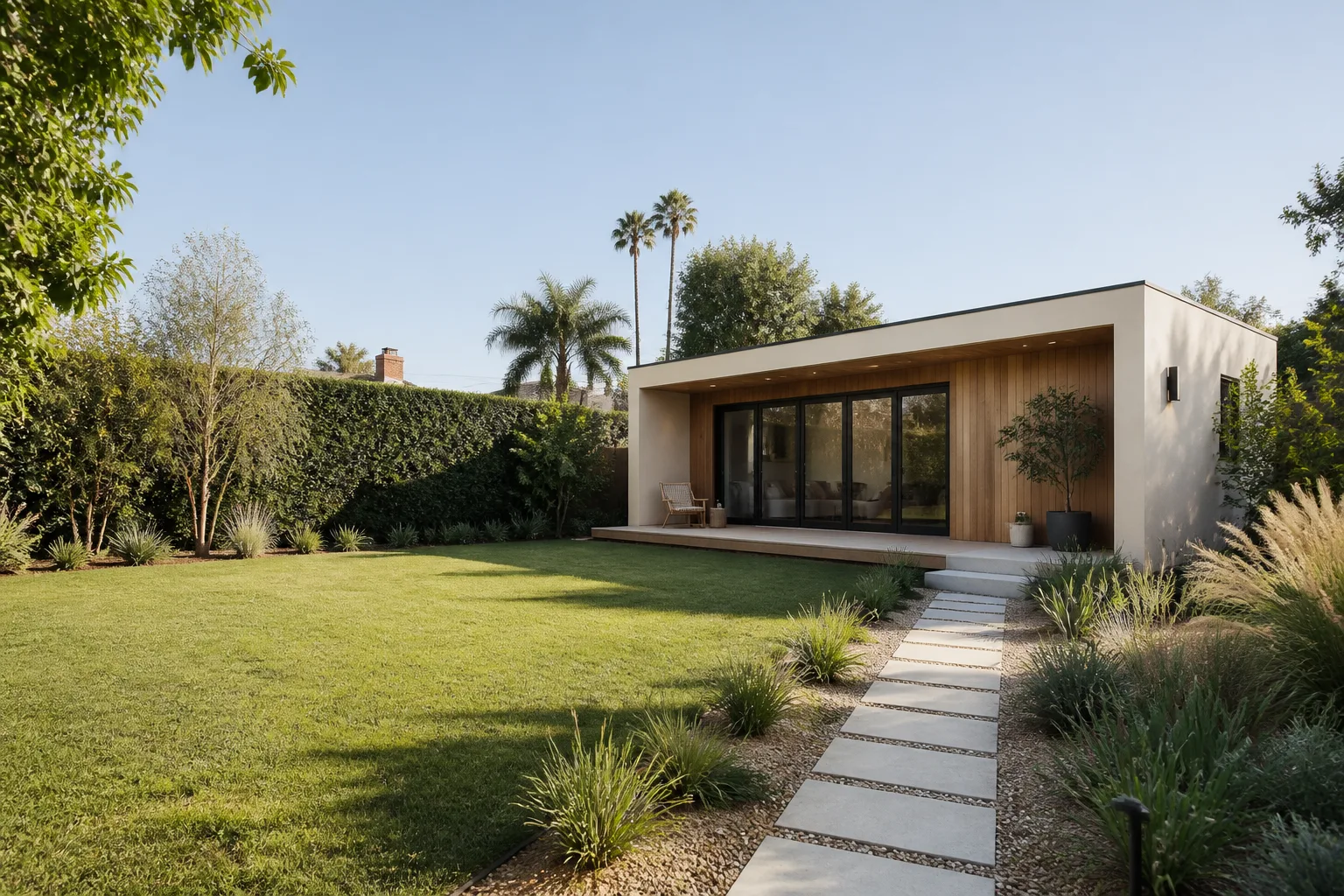
Premium budgets buy you the prefab manufacturers that handle everything off-site. Companies like Abodu and Cover build units in factories and install them on your lot in weeks rather than months. The price includes cabinetry, appliances, plumbing fixtures, and finishes that would cost much more in a site-built project. You’re also paying for the crane delivery, custom foundation, and the engineering that goes into a factory-built structure. The result is a unit that feels like a custom home addition, not a rental unit.
One note from experience: lumber prices in North Texas have stabilized somewhat since 2022, but they remain 15 to 20 percent above pre-pandemic levels. That alone moves a 600-square-foot frame by $3,000 to $4,000. Dallas also sits in a hail zone, which means your roofing material choice affects not just the build cost but your insurance premium for years after.
Dallas Permit and Inspection Fees, Itemized
Dallas Development Services charges specific fees for ADU construction, and they’re modest compared to coastal cities but not trivial. Budget $1,500 to $4,000 for permits and inspections depending on your project scope. See ADU Permits, Codes & Inspections in TX: What You Need to Know for full details. Here’s the itemized breakdown for a typical 600-square-foot detached ADU:
| Permit or Fee | Typical Cost in Dallas |
|---|---|
| Building permit (based on valuation) | $800 – $2,200 |
| Electrical permit | $150 – $400 |
| Plumbing permit | $150 – $400 |
| Mechanical (HVAC) permit | $100 – $300 |
| Plan review fee | $200 – $500 |
| Impact fee (varies by district) | $0 – $1,200 |
| Inspection fees (each inspection) | $75 – $150 per visit |
Expect four to six inspections for a standard ADU build: footing, framing, rough electrical, rough plumbing, insulation, and final. That’s $450 to $900 just for the inspections themselves, separate from the permit fees above. If you’re in a historic district or a conservation district like Swiss Avenue or Winnetka Heights, plan review takes longer and may require additional fees for preservation review.
The permit process in Dallas is also notably slower than in surrounding suburbs. Current plan review times for residential accessory structures run three to six weeks before you get approval to break ground, and that’s assuming your drawings are complete and correct on the first submission. A resubmission adds another two to four weeks.
The Utility Connection Costs Most Quotes Leave Out
Here’s where Dallas ADU budgets break. When a contractor quotes you $220 per square foot for a detached unit, they’re frequently quoting just the structure. The wire, pipe, and equipment needed to connect that structure to city services is listed as “by others” in fine print, or omitted entirely. In Dallas, these costs are substantial because the city requires dedicated service connections for permanent dwelling units, not extensions of the main house circuits.
Electrical Service
A detached ADU needs its own electrical feed, which means either a sub-panel fed from your main panel or a completely separate meter. A sub-panel installation with trenching, conduit, and wire typically costs $3,000 to $6,000 in Dallas. If your main panel is already at capacity, you’ll need a panel upgrade or a new service drop, which runs $4,000 to $8,000 before the sub-panel work even begins. A completely separate meter from Oncor adds $5,000 to $12,000 depending on transformer distance and whether overhead or underground service is feasible on your street.
Water Service
Every detached ADU in Dallas needs its own water service line from the city main or a dedicated branch from your existing meter with a backflow preventer. Trenching and installing a new water line runs $2,500 to $6,000 for a typical 40 to 80-foot run. If your ADU sits more than 100 feet from the meter, expect $6,000 to $10,000. The city will also require a separate water shutoff for the unit, which adds $500 to $1,000.
Gas Service
If you want a gas cooktop, water heater, or furnace in your Dallas ADU, you’ll need a gas line extension or a separate meter from Atmos Energy. A straightforward line extension from the existing house meter runs $1,500 to $3,500. A separate meter, which Atmos often requires for rental units, costs $4,000 to $8,000. Many Dallas homeowners skip gas entirely and go all-electric, which eliminates this line item but shifts cost to the electrical panel side.
Combined, plan for $8,000 to $25,000 in utility connections on a detached Dallas ADU, with $10,000 to $15,000 being the most common range for units within 50 feet of existing infrastructure. This is the number that makes a $150,000 ADU quote into a $165,000 project, and it’s the reason we always include utility connections in our written estimates from day one. You can see how this applies to larger scope projects on our Home Addition Contractor in Dallas page.
Hidden Cost Categories That Inflate Final Bills 15 – 30%
Utility connections are the big one, but they’re not the only line item that Dallas contractors leave off initial quotes. These categories account for the gap between what you sign and what you pay:
Site Preparation
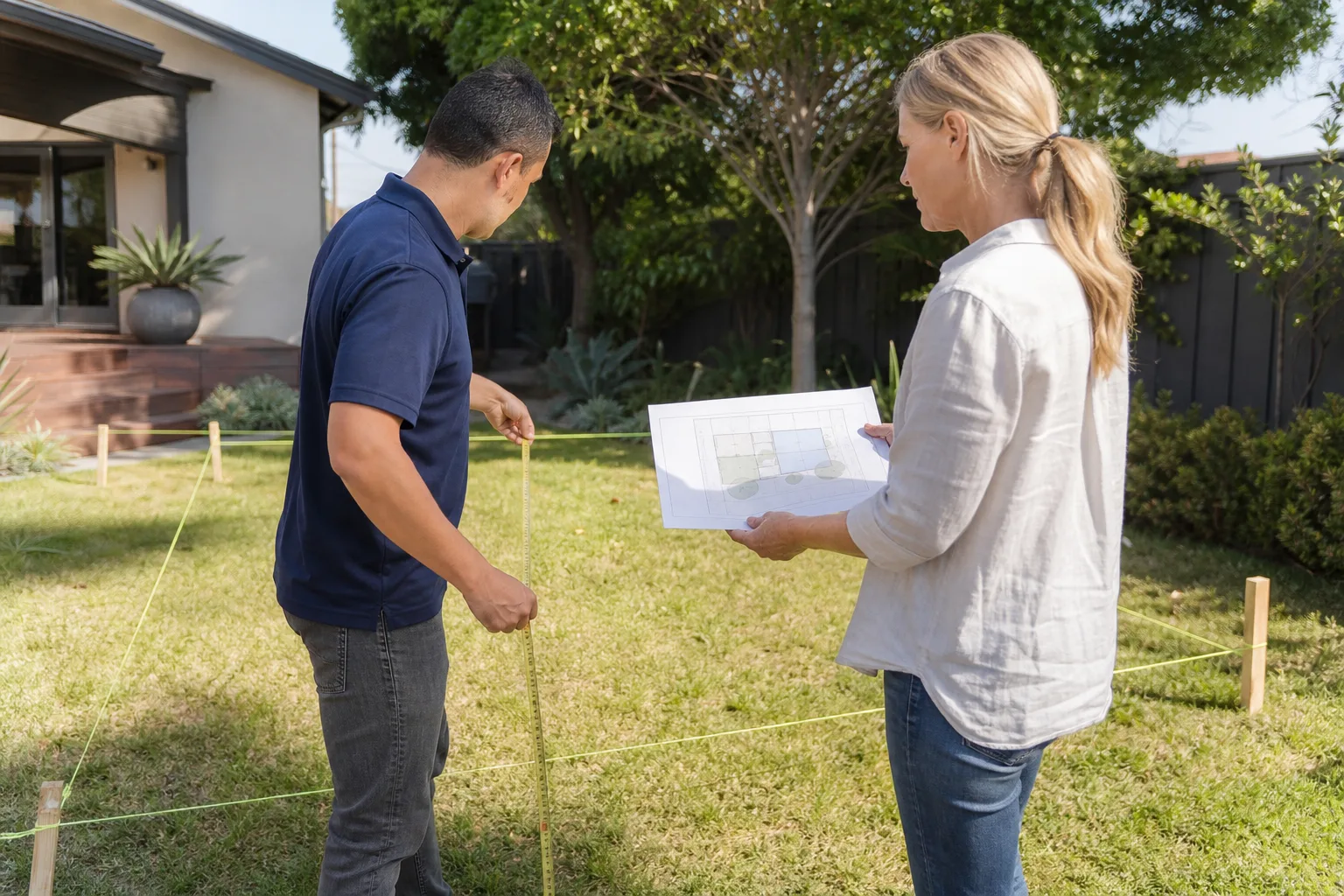
Dallas sits on a mix of blackland prairie clay and rocky limestone, and both affect foundation work. Expansive clay soils shift with moisture changes, which is why many Dallas ADU foundations require piers or a post-tension slab rather than a simple monolithic pour. That upgrade adds $4,000 to $12,000. If your lot has significant slope, add $5,000 to $15,000 for grading, retaining walls, or a stepped foundation. And if your build site has trees, Dallas tree protection ordinances may require an arborist consultation and root protection measures, adding $500 to $3,000 even when no tree is removed.
Concrete and Access
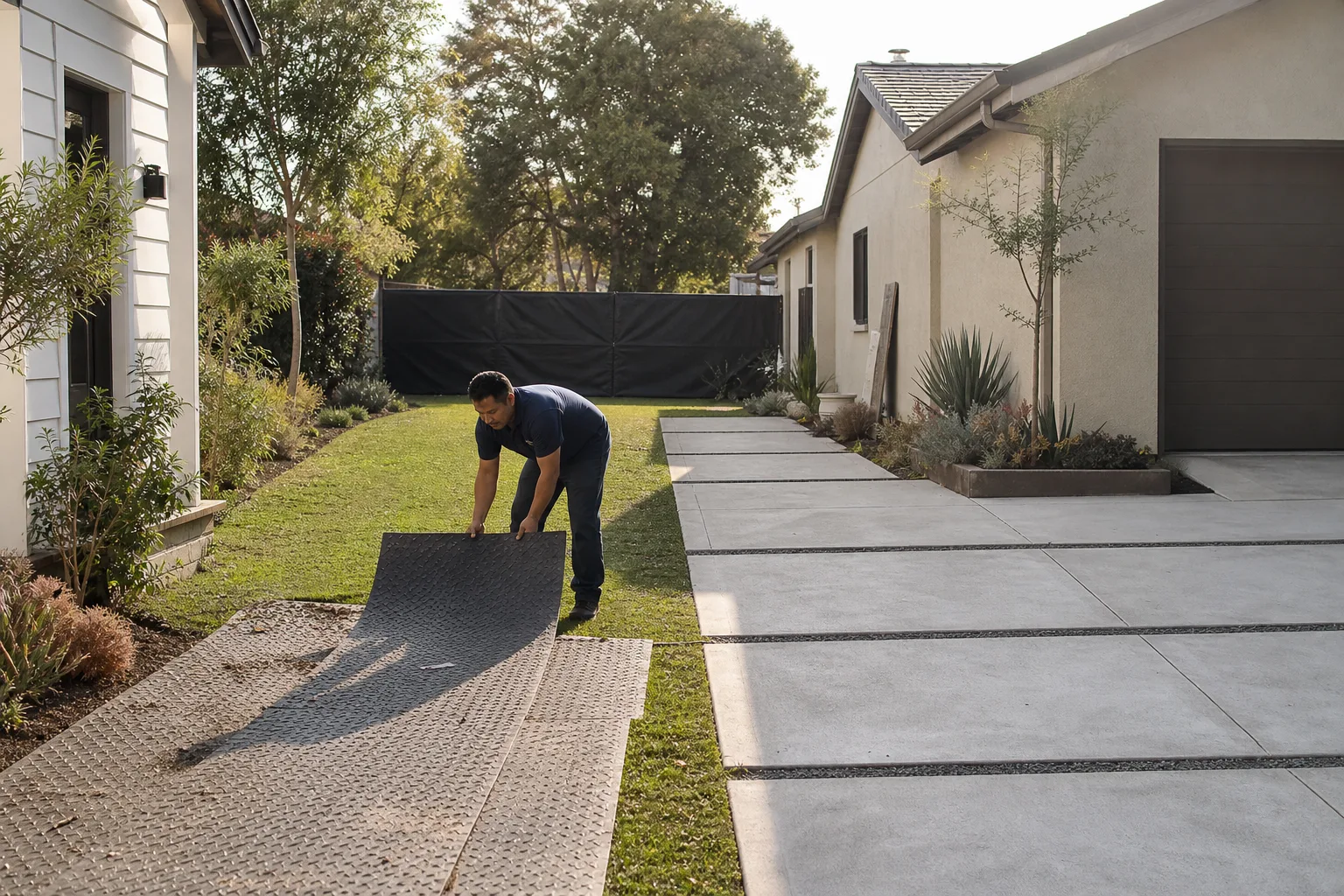
An ADU needs a path to it, and that path costs more than most people expect. A 4-foot-wide sidewalk from the main house to the ADU runs $1,500 to $3,000. A driveway extension or new parking pad adds $4,000 to $10,000 depending on whether you need to cut existing curb. If the ADU sits behind a fence and the lot is narrow, you may need temporary access for equipment that involves removing and reinstalling a fence section, adding $1,000 to $2,500.
Temporary Power During Construction
Most quotes assume the site has power available. On a detached ADU, power often needs to be routed or established before the permanent service is connected. Time spent on temporary power rentals, extension cords, and generator fuel adds $500 to $2,000 over a three-month build. It’s a small line item relative to the total, but it’s exactly the kind of cost that shows up in a change order at the end.
Permit Corrections and Resubmission
If your plans come back from Dallas Development Services with correction comments, your architect or drafter charges for revisions. Budget $500 to $2,000 per resubmission cycle. This is avoidable with complete drawings on the first submission, but most homeowner-drawn plans need at least one correction cycle.
Add these categories together on a typical 600-square-foot Dallas detached ADU and you’re looking at $15,000 to $35,000 in costs that rarely appear on the first quote. That’s the 15 to 30 percent gap between the initial number and the final bill, and it has nothing to do with upgrades or owner changes.
How to Read a Line-Item Bid Like a Dallas Contractor
Contractors write bids to look complete while giving themselves room to charge more later. Here’s how to read between the line items and spot what’s been left out versus what’s legitimately excluded, and watch for ADU Warning Signs: A Dallas Homeowner’s Reference Guide:
- Look for “allowances” in the interior finish categories. A $3,000 lighting allowance on a 600-square-foot ADU is unrealistically low for anything beyond builder-grade fixtures. If the allowance number looks small, that’s where your upgrade costs will land.
- Check whether “site utilities” appears as a line item at all. If it’s missing or marked “TBD,” the contractor has excluded one of the most expensive parts of the project. Ask for the specific trenching, conduit, and panel costs in writing.
- Verify that “concrete” includes the flatwork you actually need. Foundation concrete is usually listed, but sidewalks, parking pads, and mow strips often fall under “site work” or get omitted. If the bid doesn’t mention “flatwork” or “site concrete,” it’s not included.
- Read the “exclusions” section carefully. Legitimate bids include a line that lists what’s not covered: tree removal, landscaping restoration, fence repair, painting touch-up on the main house. Items in the exclusions list are your responsibility, and they’re predictable. Items that don’t appear anywhere are the trap.
- Ask what the line-item total assumes about your specific site. A bid that says “foundation: standard monolithic slab at $8,500” is assuming flat ground, good soil, and no tree roots within the footprint. If your yard does not match that assumption, the contractor will bill the difference. Get the assumptions in writing next to the line item.
- Compare the total against the per-square-foot math. Divide the bid total by the square footage. If the result is below $180 for a detached Dallas ADU, something significant is missing. No contractor in this market builds a code-compliant detached unit for less than that and stays in business.
The Kingswell Guarantee approach works differently. Every project we build gets a written price with explicit line items for permits, utilities, site work, and finishes before any work begins. If a cost category is excluded, it’s listed as excluded with a reason. You can see that same approach applied to garage conversions on our Garage Conversion Contractor in Dallas page.
Common Mistakes to Avoid
- Budgeting from California numbers. Bay Area and Los Angeles ADU costs run 40 to 60 percent higher than Dallas. Using those figures as a benchmark means you overbudget by tens of thousands and may shrink your project unnecessarily.
- Signing a “cost-plus” contract with no cap. Cost-plus means you pay whatever the materials and labor cost plus a markup. In a volatile materials market, that’s an open checkbook. Dallas contractors who offer cost-plus without a guaranteed maximum price are asking you to carry their material risk.
- Assuming your garage slab is ready for conversion. Many Dallas garages sit on slabs poured without rebar, without perimeter footings, and without a vapor barrier. Converting that garage means cutting in footings or pouring a new slab, adding $8,000 to $15,000 that the conversion price didn’t include.
- Skipping the tree survey on a wooded Dallas lot. Dallas has specific protected tree ordinances in many neighborhoods. Cutting a protected oak without approval runs into thousands in fines, not to mention the cost of professional tree removal when it’s permitted.
- Overlooking the long-term utility billing logic. A single meter with a sub-meter means you’re reading both usage streams, which complicates fair billing if you rent the ADU. A separate meter costs more upfront but simplifies everything after move-in.
- Not asking who pulls the permits. In Dallas, the property owner or a licensed contractor must pull building permits. If a contractor asks you to pull the permit as “owner-builder” to save money, you become legally responsible for code compliance on a structure you didn’t build.
- Believing the first number on the first quote. Every contractor bids differently. Get three written line-item bids and compare them side by side. The lowest bid is usually the one with the most omissions, not the best deal.
When to Call a Professional
An ADU is a full residential construction project with structural, electrical, plumbing, and life-safety requirements. If your project involves new foundations, utility connections, or structural changes to an existing building, you need a licensed contractor who carries the right insurance and knows Dallas Development Services requirements. The stakes are high: an improperly permitted ADU can block a future home sale, and a faulty electrical or plumbing installation is a fire and water hazard. This is not a DIY project at any meaningful scale. If you’re planning an ADU in Dallas and want a written price before any work begins, Lodgewick ADU Dallas offers free estimates across the metro area. Call (361) 204-4652 and we’ll walk your property, answer questions about scope and budget, and provide a line-item written estimate within a few days.
Frequently Asked Questions
A 600-square-foot detached ADU in Dallas costs $108,000 to $204,000 all-in, including permits, utility connections, site work, and interior finishes. The spread depends on foundation type, finish level, and whether you choose a prefab manufacturer or site-built construction. Call (361) 204-4652 for an exact quote on your specific lot and scope, estimates are free.
Yes, a Dallas garage conversion costs $80 to $160 per square foot versus $180 to $340 for new detached construction, because the walls, roof, and foundation already exist. However, existing garages often need structural upgrades, new slabs, and electrical service improvements that add $10,000 to $20,000, narrowing the gap significantly on older properties.
Not if you have a written fixed-price contract with all line items specified, which is The Kingswell Way we follow at Lodgewick ADU Dallas. Price changes happen when contractors use cost-plus contracts, when site conditions differ from what the bid assumed, or when items were omitted from the original scope. Get the exclusions in writing and ask who absorbs the cost if the foundation hits rock or the panel needs an upgrade.
Yes. Every permanent accessory dwelling unit in Dallas requires building, electrical, plumbing, and mechanical permits from Dallas Development Services, plus a plan review and inspections at multiple stages. Building without permits makes the structure illegal, complicates insurance claims, and creates a title defect when you sell. Call (361) 204-4652 and we’ll handle the full permit process for you.
Plan on four to eight months from design to move-in for a site-built detached ADU, including three to six weeks for Dallas permit review, two to four months of construction, and final inspections. Prefab units from companies like Abodu or Cover can cut construction to four to eight weeks after permits are approved, though the permit timeline stays the same.
Yes. Common financing routes include a home equity loan, a cash-out refinance, a construction loan that converts to permanent mortgage, or specialized ADU financing programs. Dallas property values support meaningful equity borrowing on most homes, and the added value of a permitted ADU typically ranges from 50 to 70 percent of construction cost, which factors into your lender’s underwriting.
The Bottom Line
A Dallas ADU in 2026 costs $80 to $340 per square foot depending on type, with a typical detached 600-square-foot unit landing between $108,000 and $204,000 all-in. The numbers that surprise Dallas homeowners are the ones that never appeared in the first quote: utility connections, site preparation, and concrete flatwork. Before you sign anything, get a written line-item bid that names every category, states what’s excluded, and commits to a fixed price. Then verify the permit process, the inspection schedule, and what happens if the work falls short. A real ADU builder in Dallas will put every one of those commitments in writing before the first board is cut. Explore more guides & resources to plan your project with confidence.
Written by Russ Delmar, Owner at Lodgewick ADU Dallas, serving Dallas since 2010.