Last updated October 15, 2026
How to Hire a ADU Contractor in Dallas: A Step-by-Step Guide
Here’s the blunt truth from our fifteen years building accessory dwelling units across Dallas: the homeowners who lose the most money are not the ones whose project hits a snag. They are the ones who signed a contract without five specific documents in hand, then watched the price climb and the warranty evaporate. The Texas Attorney General logged more than 4,000 residential contractor complaints in a recent year, and the single most common pattern was a contractor who took a deposit, started work, then stopped returning calls when the framing was exposed and the problems started appearing. This guide and our more guides & resources will show you exactly how to separate the builders who put their promises in writing from the ones who bank on you not knowing the difference. We are going to walk through the documents you need before any money changes hands, the questions that expose a bad bid, and the Dallas-specific red flags that most guidebooks skip entirely.
Quick Answer
Hiring an ADU contractor in Dallas comes down to getting five documents before you sign: a written scope of work, an itemized price, a payment schedule tied to completed milestones, proof of Texas license and insurance, and written warranty terms. A legitimate builder will provide all five without being asked, will give you a written price before any work begins, and will put the arrival window and the guarantee in writing. If a contractor gives you a verbal price and a handshake, walk away before you write the deposit check.
Table of Contents
- The Five Documents You Must Receive Before Signing Any ADU Contract in Texas
- How to Verify a Texas Contractor’s License and Insurance in Under 10 Minutes
- What a Legitimate ADU Bid Looks Like Line by Line
- The Three Questions to Ask Every Reference (and Why “Were You Happy?” Is Useless)
- Dallas-Specific Red Flags That Should End the Conversation
- The Payment Schedule That Protects Your Money
- Permits in Dallas: What Your Contractor Should Handle and What You Should Never DIY
- Prefab vs. Stick-Built: How Material Choice Affects Your Timeline and Budget in Dallas
- Common Mistakes to Avoid
- When to Call a Professional
- Frequently Asked Questions
- The Bottom Line
The Five Documents You Must Receive Before Signing Any ADU Contract in Texas
Most contractor disputes in Dallas start the same way: someone signed a one-page agreement that said “build ADU per plans” and nothing else. Then the tile they wanted became an upgrade, the electrical panel replacement became a change order, and the crew who showed up was not the crew who measured the lot. None of that happens when the paperwork is complete. Before you sign anything, a legitimate ADU contractor in Dallas should hand you five documents. If they balk at any of them, that is your signal to find another builder.
The first is a written scope of work. This is not a marketing brochure. It is a room-by-room, system-by-system description of exactly what will be built: the square footage, the ceiling height, the number and type of windows, the insulation R-value, the electrical panel capacity, the plumbing fixtures, the flooring material, the paint finish. Every item should be described specifically enough that two different subcontractors would quote the same thing. “Build ADU” is not a scope. “Construct 749 sq ft one-bedroom ADU with LP SmartSide siding, R-21 batt insulation in walls, a 100-amp subpanel with four 20-amp circuits, a tankless water heater, and LVP flooring throughout” is a scope.
The second is an itemized price. Not a lump sum. A line-by-line breakdown: site prep, foundation, framing, roofing, siding, electrical rough-in, electrical finish, plumbing rough-in, plumbing finish, HVAC, drywall, paint, flooring, fixtures, trim, permits, and a contingency line. Some builders resist itemizing because it makes their margins visible. That is exactly why you want it. When a price is itemized, a change order has to reference a specific line item, and you can see whether the price is fair or padded.
The third is a payment schedule tied to completed milestones. Never to dates. Never “50% at signing, 50% at completion of framing.” The schedule should read like this: 10% at contract signing, 20% after foundation passes inspection, 20% after framing passes inspection, 20% after rough-in inspections pass, 20% after drywall is complete, 10% after final inspection and punch list. Each payment releases only after the milestone is inspected and you have walked the site yourself, as detailed in our ADU Permits, Codes & Inspections in TX: What You Need to Know. A contractor who asks for 50% up front in Dallas is either undercapitalized or planning to use your money to finish someone else’s job. Both are reasons to run.
The fourth is license verification in writing. Not “yeah, we’re licensed.” A copy of the actual Texas Department of Licensing and Regulation (TDLR) license, the license number, and the name on the license matching the name on the contract. We have watched Dallas homeowners discover after a dispute that the “company” they paid was actually an unlicensed individual using a borrowed license number. The document should also include a certificate of insurance with you named as an additional insured.
The fifth is written warranty terms. What is covered, for how long, and what happens if something fails. A one-year workmanship warranty is standard in Texas. Longer is better. The key is that it is written. A verbal promise to “make it right” is not a warranty. A written guarantee that states the builder will return and repair defects in materials or workmanship for a defined period, at no cost to you, is. At Lodgewick ADU Dallas, every project includes the 365-Day Done Right Promise in writing before work begins: if the work is not right, we come back and make it right. That commitment is in your contract file, not in a conversation you will have to reconstruct later.
How to Verify a Texas Contractor’s License and Insurance in Under 10 Minutes
Texas does not require a general contractor’s license for most residential work, which surprises a lot of Dallas homeowners. Electricians and plumbers must hold state licenses through TDLR, but the general contractor coordinating your ADU may not need a state-issued license at all. That does not mean you skip verification. It means you verify what actually exists: the trade licenses for the electrical and plumbing work, the business registration, and the insurance.
Here is the ten-minute verification process, step by step:
- Pull the electrician’s license. Go to TDLR’s website, click “License Search,” and enter the electrician’s name or license number. Confirm the license is active, not expired or suspended. Your ADU’s electrical work in Dallas must be performed by a licensed Texas electrician. No exceptions.
- Pull the plumber’s license. Same TDLR search, plumbing category. Confirm active status. The plumber who roughs in your kitchenette and bathroom must hold a current Texas plumbing license.
- Ask for the certificate of insurance. The contractor should provide a COI from their insurer naming you as an additional insured. Call the insurance company’s verification line (listed on the COI) and confirm the policy is active. This takes three minutes and catches lapsed policies that fake COIs hide.
- Check the business registration. Search the Texas Comptroller’s office for the business name. Confirm the entity is active and in good standing. A builder who lets their registration lapse is a builder who lets other things lapse too.
- Confirm the name on the contract matches the name on the license and insurance. If the contract says “Dallas ADU Pros LLC” but the insurance says “John Smith,” ask why. If the answer is not immediate and clear, reconsider.
This process takes ten minutes. It will not catch every bad actor in the Dallas market, but it catches the lazy ones, and the lazy ones are the ones who cause most of the problems.
What a Legitimate ADU Bid Looks Like Line by Line
A legitimate ADU bid in Dallas runs eight to fifteen pages. A lowball bid runs two. Here is what the real one contains, and what disappears when a contractor is lowballing to win the job and planning to recover the margin through change orders later.
Site work. The bid should include clearing, grading, and any tree removal or root barricades required by Dallas code. Clay soil is the reality across Dallas. A bid that does not include soil testing or compaction for the foundation is a bid that will surprise you with a foundation change order when the crew starts digging and hits expansive clay that moves more than expected.
Foundation. This line item should specify the type (slab on grade for most Dallas ADUs), the concrete strength, the steel reinforcement schedule, and the termite pretreatment. Post-tension or pier-and-beam should be specified if the lot conditions require it. A vague “foundation included” line is a red flag.
Framing. The bid should list lumber species and grade (Douglas fir or SPF, #2 or better), the stud spacing (16 or 24 inches on center), and the roof framing type. It should also include the seismic and wind load details required by Dallas building code.
Electrical. This is where lowball bids cheat. A real bid lists the panel size (typically a 100-amp subpanel for an ADU), the number of circuits, the number of outlets and switches by room, the lighting fixture count, and the connection to the main panel. A bid that says “electrical included” without specifics will generate change orders the moment you ask for an outlet where the plan did not show one.
Plumbing. Same pattern. The bid should specify the water line size, sewer connection method, water heater type (tankless or conventional), and the fixture count by room. Trenching through Dallas clay is expensive. If the bid does not include trenching depth and backfill details, the price is not real.
HVAC. Dallas summers run hot. The bid should specify the system type (mini-split is common for ADUs), the BTU rating, the SEER efficiency rating, and the number of zones. An undersized system is cheap up front and miserable in August. A good builder will calculate the load, not guess.
Finishes. The bid should itemize flooring material and square footage, paint (including primer and number of coats), trim style, door hardware, and cabinet grade. An allowance line (“cabinet allowance: $2,500”) is acceptable if the allowance is realistic, but the bid should state what the allowance covers.
Permits and inspections. This line should list the specific permits: building permit, electrical permit, plumbing permit, mechanical permit, and any Dallas-specific requirements like tree preservation review. The bid should state who pulls the permits and who schedules inspections. A legitimate builder pulls the permits in their name.
The items that disappear from lowball bids? Site work contingencies, soil testing, permit fees, dumpster and debris removal, and the punch list allowance. They disappear because they are easy to hide, and they reappear as change orders at $400 to $1,200 each. That is how a $120,000 bid becomes a $160,000 project. Our team at Lodgewick ADU Dallas provides a written, itemized price before any work starts, every time. No price changes at the door, no hidden line items that surface after the foundation is poured.
The Three Questions to Ask Every Reference (and Why “Were You Happy?” Is Useless)
Every contractor can produce three references who will say the work was great. That is not information. That is marketing. The value in a reference call comes from asking questions the contractor did not coach the reference to answer. Here are the three that reveal what actually happened on the job:
Question one: “What did you pay, and what did the final bill come to?” This question works because it is specific and numeric. If the reference paid exactly what the bid said, the contractor holds their price. If the final bill was 15% higher, you now know what to expect. Most references will answer this honestly because it is a factual question with a factual answer. In our experience in Dallas, the answer to this question predicts your experience better than any other single data point.
Question two: “When the crew was on site, did they show up at the time they said they would?” Not “were they professional.” Professional is a feeling. Showing up at 8:00 when they said 8:00 is a fact. Ask the reference to describe a typical workday. Did the crew arrive at a consistent time? Did they tell the homeowner when they would be there? A crew that respects the arrival window respects the homeowner, and a crew that does not will cause you a dozen small frustrations over a four-month build.
Question three: “Has anything gone wrong since the project was finished, and what happened when you called about it?” This is the question that matters most. Every build has something go wrong. A drawer pull comes loose. A rain gutter drips. The question is not whether something failed. The question is whether the contractor answered the phone and came back. A reference who says “there was a small leak under the sink and they came back the next week and fixed it” is worth ten references who say “no problems at all.” A reference who hesitates, or says “well, we had a little issue and it took a while” is telling you how your warranty call will go. The Kingswell Guarantee that our garage conversion team in Dallas operates under exists for exactly this reason: a written guarantee that includes a free return visit if the work fails within the 365-day period. Ask every reference the same question and compare the answers.
Dallas-Specific Red Flags That Should End the Conversation
Some red flags are universal: no written contract, cash-only discounts, pressure to sign today. But Dallas has its own specific warning signs that come from the local market, the local code environment, and the local climate. Here are the ones we tell every Dallas homeowner to watch for.
No permit-pulling experience in your municipality. Dallas proper has different permitting processes than Garland, Mesquite, Richardson, Plano, Irving, and the other cities scattered across the metroplex. Each municipality has its own quirks, its own permit offices, its own inspection staff. A contractor who has never pulled a permit in your specific city is learning on your timeline. Ask directly: “How many permits have you pulled in the city of Dallas in the last two years?” If the answer is a round number with no specifics, be suspicious. If the answer is “well, permits are basically the same everywhere,” end the conversation. They are not.
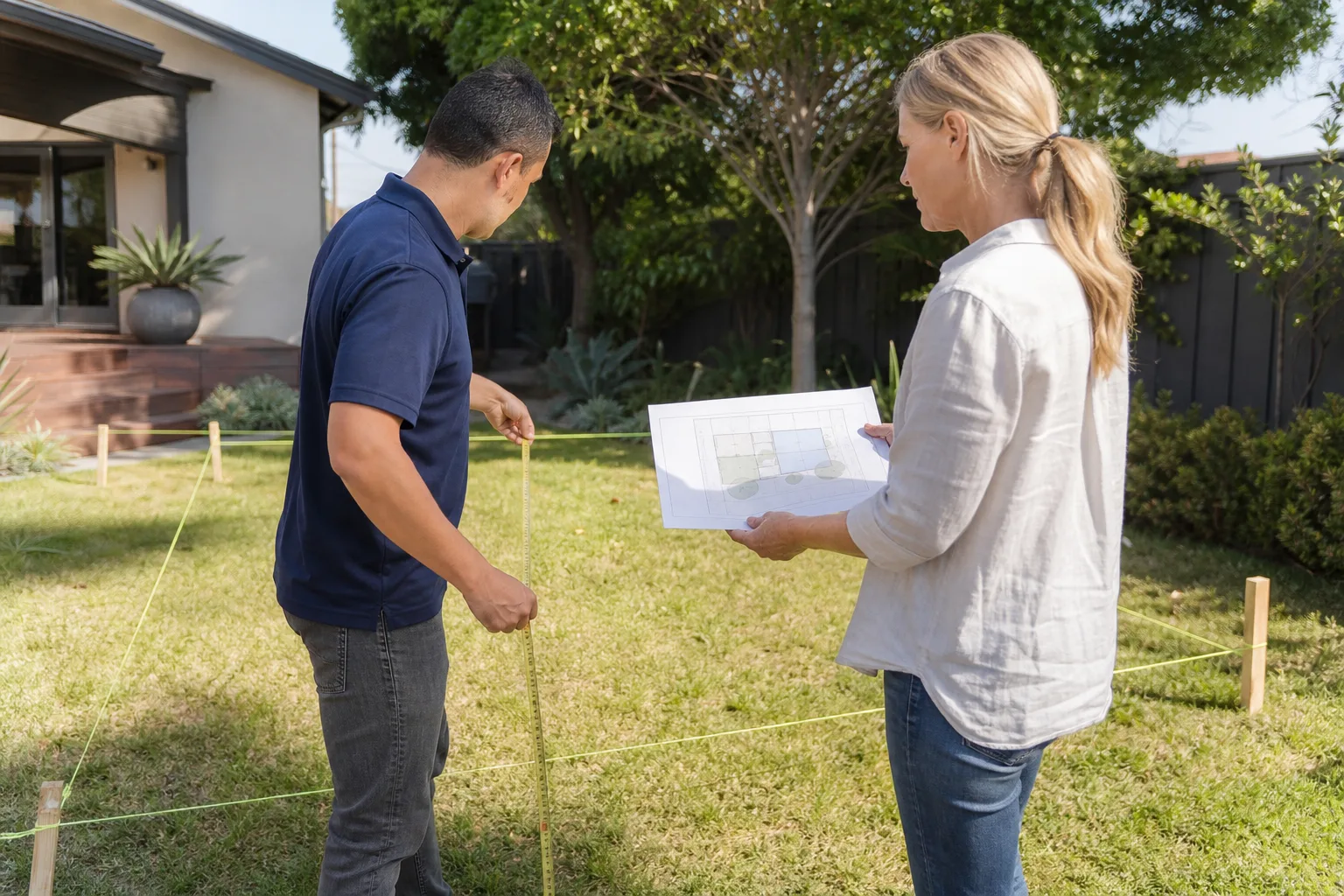
Price given before a site visit. A real ADU bid cannot be produced from a phone call. The lot slope, the sewer line location, the electrical panel location, the access for equipment, the tree cover, the soil type, the setback requirements from your specific lot dimensions: all of these affect the price, and none of them are visible from a satellite photo. A contractor who quotes you a firm price before walking the lot is guessing. A contractor who guesses on price will also guess on scope. Walk away.
Unwillingness to put the arrival window in writing. In Dallas, the construction season is long and the labor market is tight. Builders have work. That is fine. What is not fine is a builder who will not write down when their crew will arrive and how the schedule will be communicated. The Kingswell Way, which our home addition team in Dallas follows on every job, includes a defined arrival window in writing. If a contractor will not commit a window to paper, they are telling you that their schedule is more important than yours.
No experience with Dallas clay soil. The soil across most of Dallas is expansive clay. It shrinks in drought and swells in rain. A foundation that is not designed for this movement will crack. A contractor who does not talk about soil testing, moisture barriers, and foundation design for expansive soil is either inexperienced in this market or cutting corners. Either way, you do not want them building your ADU.
The deposit is due before the permit application is filed. A $30,000 deposit on a $150,000 ADU with no permit filed and no site work started is a loan to the contractor at zero percent interest. In Texas, there is no legal limit on what a contractor can ask for up front, which means the market decides. The market standard for a reputable Dallas ADU builder is 10% at signing. Anyone asking for 30% or more before the permit is pulled is not following market practice. They are following their own cash flow problem.
The Payment Schedule That Protects Your Money
The payment schedule is the most underrated protection in an ADU contract. It is also the place where homeowners make the most avoidable mistakes. The goal of a payment schedule is simple: never let the contractor hold more of your money than the amount of completed work on your property. If they have $50,000 of your money and $20,000 of work on the ground, you are exposed. If they have $15,000 of your money and $30,000 of work on the ground, they are exposed. You want them exposed, not you.
Here is the schedule that accomplishes that balance on a typical $150,000 ADU in Dallas:
- 10% ($15,000) at contract signing. This covers design finalization, permit drawings, and mobilization. It is enough to show good faith without putting you at material risk.
- 20% ($30,000) after foundation passes inspection. The concrete is poured, the inspection is signed off, and the work is physically on your property. You have seen it.
- 20% ($30,000) after framing passes inspection. The walls are up, the roof is on, and the structure is enclosed. Another milestone you can verify by walking the site.
- 20% ($30,000) after rough-in inspections pass. Electrical, plumbing, and HVAC rough work is complete and inspected. The city has signed off.
- 20% ($30,000) after drywall and finishes are complete. The interior is finished. Floors, paint, cabinets, fixtures are installed.
- 10% ($15,000) after final inspection and punch list. The city has issued the certificate of occupancy, your punch list items are resolved, and you have walked the unit room by room.
This schedule keeps the contractor ahead on labor costs but never more than a milestone ahead of your money. If the contractor walks off the job halfway through, you have paid for roughly the work that exists. You are not whole, but you are not destroyed. A contractor who demands a different structure should explain why in writing. If the explanation is not compelling, find another contractor.
Permits in Dallas: What Your Contractor Should Handle and What You Should Never DIY
ADU permits in Dallas are not optional, and they are not simple. The city of Dallas requires a building permit, an electrical permit, a plumbing permit, and a mechanical permit for an accessory dwelling unit. Depending on your lot, you may also need a tree preservation review, a floodplain determination, or a historic district review. Your contractor should handle all of this. If a contractor suggests you pull the permits yourself to save money, that is a red flag wrapped in a discount.
When a homeowner pulls the permit, the homeowner becomes the responsible party in the eyes of the city. That means if something goes wrong, if the work does not pass inspection, if there is a dispute with the contractor, the city looks to you. When the contractor pulls the permit, the contractor is accountable. A builder who is willing to let you take on that liability is a builder who does not want the liability for a reason.
Here is what the permit process looks like in Dallas and what your contractor should be doing at each step:
- Plan review. Your contractor submits the ADU plans to the city’s building inspection division. The city reviews for zoning compliance, building code compliance, and energy code compliance. This typically takes four to eight weeks in Dallas depending on the current volume.
- Permit issuance. Once plans are approved, the city issues the building, electrical, plumbing, and mechanical permits. Your contractor posts the permit on site.
- Inspections at each phase. Foundation, framing, rough electrical, rough plumbing, rough mechanical, insulation, drywall, and final. Each requires a scheduled inspection by a city inspector. Your contractor coordinates these. You should be notified when each inspection passes or fails, and what the resolution was if it failed.
- Certificate of occupancy. After final inspection passes, the city issues a CO. Your ADU is now legal to occupy. Do not move anyone into the ADU before the CO is issued. Occupying an uninspected structure is a code violation and, more importantly, a safety risk.
In our experience in Dallas, the permitting timeline is the single biggest driver of schedule slippage. A good contractor pads the schedule for city review and inspection wait times. A bad one blames the city when the project runs two months late. Ask your contractor up front: “How are you handling the Dallas permitting timeline in this schedule?” A good answer includes specific buffer periods and a communication plan. A bad answer includes shrugs.
Prefab vs. Stick-Built: How Material Choice Affects Your Timeline and Budget in Dallas
One of the biggest decisions in an ADU project is whether to build on-site (stick-built) or use a prefabricated system from a manufacturer like Abodu, Cover, or Tuff Shed. Both approaches are valid in Dallas. The right choice depends on your lot, your budget, and your tolerance for construction time on your property.
Stick-built is the traditional method: framing lumber on a concrete slab, built room by room on your lot. It takes longer, typically six to ten months for an ADU in Dallas. But it allows complete customization, it can accommodate odd lot shapes and tight setbacks, and it uses materials that any contractor and any inspector in the metroplex knows. If you have an unusual lot or specific design requirements, stick-built is often the better path.
Prefab systems from brands like Abodu, Cover, and Tuff Shed are built in a factory and assembled on your site. The site work (foundation, utilities) happens on your lot, then the modules arrive and are set in place. The timeline is compressed significantly: site work plus a few weeks of assembly and finish work, often four to six months total in Dallas. The trade-off is less design flexibility and a dependency on the manufacturer’s production schedule and delivery logistics. Prefab units must also meet Dallas building code, which some manufacturers handle well and others do not. Your contractor’s job is to verify that the specific unit meets Dallas code before you commit.
Material siding choices matter in Dallas specifically because of the climate. Our crews work regularly with James Hardie fiber cement siding because it holds up to the Dallas summer heat without warping like vinyl and does not require the maintenance of wood. A builder who specs cheap siding to hit a price point is betting you will not know the difference until the Texas sun has had a few years to work on it.
The best approach is to talk through both options with your contractor before you commit to either. A good builder will give you an honest comparison of cost, timeline, and trade-offs for your specific lot. A bad builder will push whichever option they happen to prefer, usually the one that is easier for them.
Common Mistakes to Avoid
- Signing a contract without an itemized scope. “Build ADU per attached plans” is a lawsuit waiting to happen. Demand the room-by-room, system-by-system scope in writing. If the contractor will not provide it, they are planning to exploit the ambiguity.
- Choosing the lowest bid without comparing line items. A bid that is $25,000 cheaper than the other two is not cheaper. It is missing something. Compare line items side by side and find out what is not there.
- Paying too much up front. A Texas contractor has no legal limit on what they can ask for as a deposit. That means the number they ask for is a signal about their business. A 50% deposit is a contractor using your money as operating capital. That is not your job.
- Skipping the license and insurance check. Ten minutes on the TDLR website and a phone call to the insurance company catches the majority of the bad actors operating in Dallas. Skip it and you are hiring on faith.
- Not getting the warranty in writing. A verbal “we stand behind our work” is worth nothing in a dispute. The warranty should be a written document with the coverage period, what is covered, what is excluded, and how to make a claim.
- Pulling permits in your own name. This shifts legal liability to you and removes one of the contractor’s key accountability mechanisms. Let the contractor pull the permits. It is part of what you are paying for.
- Ignoring the Dallas soil reality. Expansive clay is not a theoretical problem. It is the ground under your ADU. Make sure the foundation is designed for it, with the soil test and the compaction details in writing.
When to Call a Professional
If you are reading this guide, you are probably already at the point where a professional should be involved. An ADU is not a deck or a shed. It is a dwelling unit with electrical service, plumbing, HVAC, and a foundation, and it has to meet Dallas building code, which means the work has to be done by licensed tradespeople. Specifically, call a professional ADU contractor in Dallas when: you have a lot that can accommodate an additional dwelling unit and you want to know what is actually buildable; you have received a bid that seems too low and you want a line-item comparison to see what is missing; you have started a project with another contractor and the arrival windows keep slipping, the change orders keep coming, or the phone has stopped ringing; or you have a written scope from another builder and you want a second opinion on pricing before you sign. Lodgewick ADU Dallas offers free estimates in Dallas, with a written itemized price provided before any work begins. Call (361) 204-4652 and a live person will answer, 24 hours a day, 7 days a week.
Frequently Asked Questions
A stick-built ADU in Dallas typically costs between $180,000 and $350,000 depending on size, finishes, and site conditions, while a prefab ADU using systems from brands like Abodu or Cover generally runs between $120,000 and $250,000 installed. For a deeper look at pricing, see our ADU Cost Breakdown: The Dallas Homeowner’s Reference for 2026. The range is wide because every lot in Dallas presents different foundation, utility connection, and permitting challenges. The only way to get an accurate number for your specific lot is a site visit and a written, itemized quote. Call (361) 204-4652 for a free estimate with a written price before any work begins.
Yes. Every ADU in Dallas requires a building permit, an electrical permit, a plumbing permit, and a mechanical permit, and depending on your lot, you may also need a tree preservation review or a floodplain determination. Your contractor should pull all of these permits in their own name. If you pull the permits yourself, you become the responsible party if anything goes wrong.
A stick-built ADU in Dallas typically takes six to ten months from contract signing to certificate of occupancy, while a prefab ADU using manufacturers like Cover or Tuff Shed can be completed in four to six months. The Dallas permitting process alone typically adds four to eight weeks to the front end of any project. A good contractor builds buffer into the schedule and communicates inspection timelines proactively.
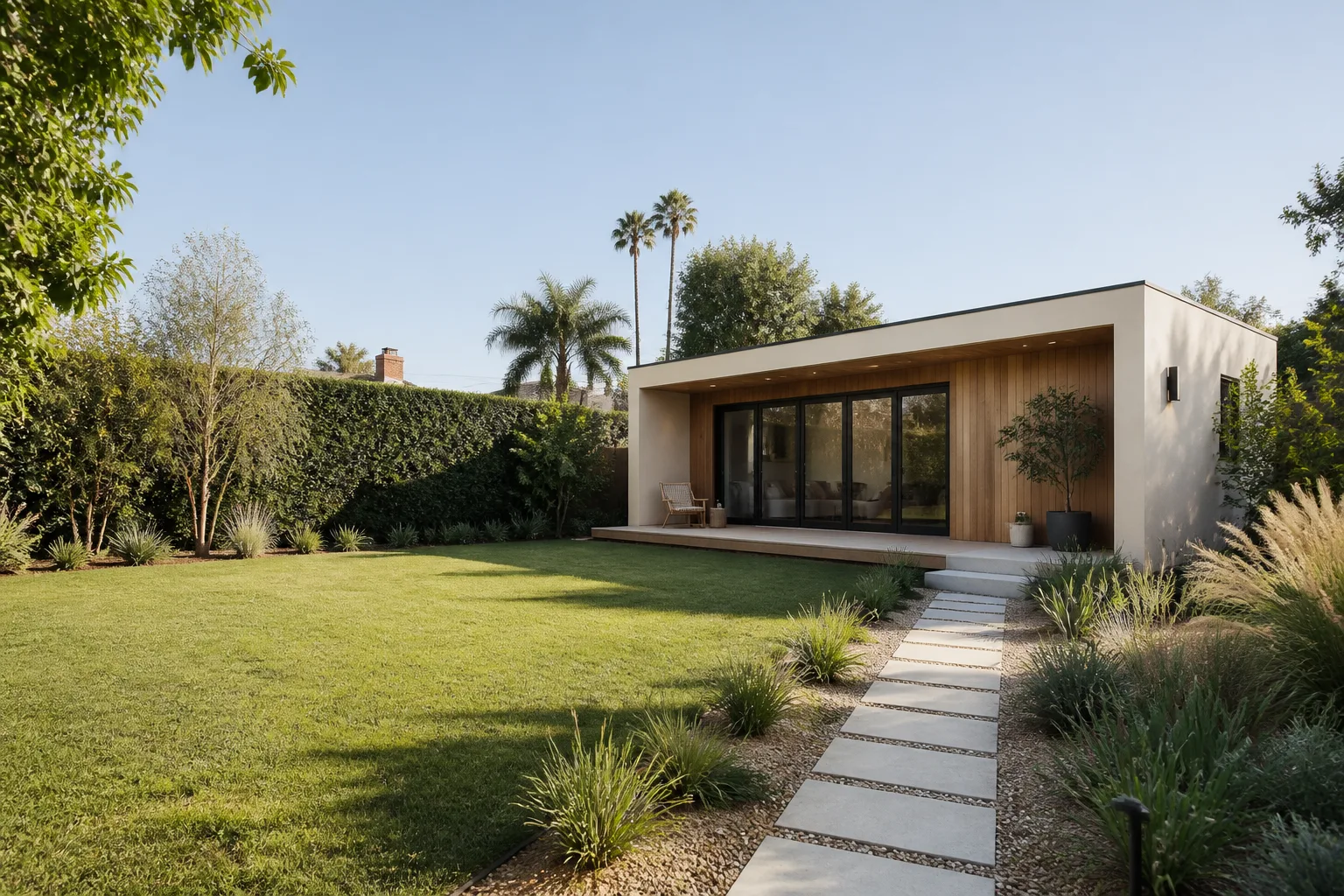
An ADU (accessory dwelling unit) is a separate, independent dwelling unit with its own kitchen, bathroom, entrance, and address, built on a property that already has a primary residence. A JADU (junior accessory dwelling unit) is a smaller unit, typically under 500 square feet, that is created within the existing footprint of the primary home, often by converting a garage or a portion of the house. Both are permitted in Dallas under certain zoning conditions, but the rules, parking requirements, and size limits differ. Your contractor should know the specifics for your zoning district.
Yes, a garage conversion in Dallas is typically 30% to 50% cheaper than a new standalone ADU because the structure already exists. You are not paying for a new foundation, framing, or roof. The cost difference depends on the condition of the existing garage, the amount of electrical and plumbing work required, and whether the existing structure meets Dallas code for habitable space. We handle garage conversions in Dallas regularly and can give you a written comparison between converting your garage and building a new unit on the same lot.
First, determine whether the additional cost is a legitimate change order for work outside the original scope, or an attempt to recover margin on work that should have been in the original bid. If the original scope was itemized and the additional item is outside it, a change order with a written price is reasonable. If the item should have been in the original scope, or if the change order keeps arriving with vague or inflated justifications, that is a red flag. This is exactly why the written scope and itemized price matter before work begins. Call (361) 204-4652 for a free second opinion if you are in this situation with a current contractor.
The Bottom Line
Hiring an ADU contractor in Dallas comes down to paper. Written scope, written price, written schedule, written warranty. The builders who put these in writing before they ask for money are the builders who will still be answering your calls after the certificate of occupancy is issued. The ones who work in verbal promises are the ones who disappear. Verify the license, check the insurance, ask the references the uncomfortable questions, and never let the payment schedule put you in a position where the contractor holds more of your money than the value of the work on your property. If you are ready to get a written itemized price for your ADU project in Dallas, call (361) 204-4652. A live person answers, 24/7, and the estimate is free.
Written by Russ Delmar, Owner at Lodgewick ADU Dallas, serving Dallas since 2010.