James Hardie New Detached ADU: The Dallas Owner’s Guide
If you’re planning a new detached ADU in Dallas with James Hardie siding, trim, or panel products, the installed cost typically runs $255 to $385 per linear foot complete, with most full builds landing between $285,000 and $385,000 depending on foundation work, utility runs, and finish level. We stock the full James Hardie line used on Dallas ADUs, including HardiePlank lap siding, HardiePanel vertical siding, HardieTrim boards, and HardieSoffit, and can have materials staged for your start date within five to seven business days. The part most owners don’t think about until it’s too late is the trim flashing system: in Dallas, the freeze-thaw cycles and July UV load chew through improperly flashed HardieTrim corners faster than anywhere else in Texas outside El Paso.
Here’s what most homeowners actually run into: they buy a property or get plans drawn, the architect specs James Hardie, and then the pricing questions start. What nobody tells you is that the siding itself is the easy decision. The gotchas are in the accessories: the starter strips, the corner flashing, the weep screed details at the foundation, and the rainscreen gap the Dallas climate actually demands. Miss those, and the prettiest HardiePlank job fails inside five years.
Which James Hardie Models This Applies To
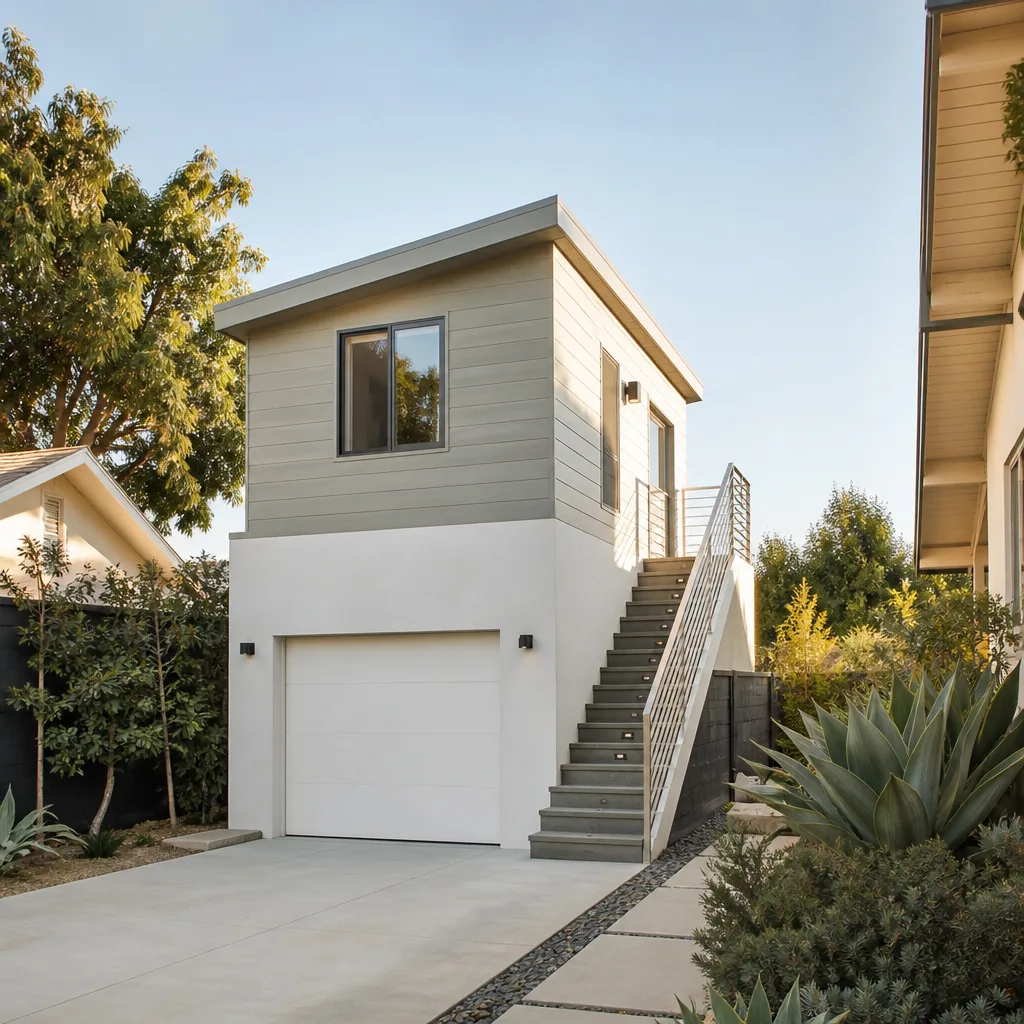
This page covers the four James Hardie product lines that show up on nearly every new detached ADU in Dallas: HardiePlank lap siding (the 5/16-inch thick horizontal boards, 8-1/4-inch exposure being the most common spec here), HardiePanel vertical siding (4×8 and 4×10 sheets, smooth or stucco texture), HardieTrim 5/4 boards for corners, windows, and door surrounds, and HardieSoffit for eave overhangs. If your plans call for HardieBacker as an exterior shear panel under stucco, that’s a separate line and gets treated differently at inspection.
The model identification matters more than most people expect. HardiePlank comes in Select Cedarmill (wood-grain texture) and Smooth finish, and they are not mix-and-match without a visible seam line at the transition. In Dallas, we spec the Smooth finish on modern detached ADUs and Cedarmill when the design leans traditional, matching the main house. Every board ships with a printed code on the back edge: look for the last four digits of that code. It tells you the plant, the line, and the color batch. Batch-mix two different runs on a hot north-facing wall in Dallas summer and you’ll see the color variation within a year, even with the baked-on ColorPlus finish. James Hardie calls their prefinished system ColorPlus Technology, and we strongly recommend it over job-site painting for one reason: the finish warranty stays intact when the board is factory-coated. Field-painted Hardie is fine, but you own the paint warranty, not James Hardie.
OEM versus aftermarket: HardieTrim uses a fiber-cement composite, not wood or PVC. Some Dallas suppliers push an aftermarket PVC trim board to save money. It moves differently in heat than fiber cement, and on a detached ADU that sits six feet from a lot line fence, that expansion difference opens corner joints. We spec genuine James Hardie trim on James Hardie siding, period. Russ Delmar has pulled too many failed PVC corners off HardiePlank walls in Lakewood and the M-Streets to do it any other way.
Signs Your James Hardie New Detached ADU Is Failing
- Paint bubbling or peeling at the bottom course within two years. This usually means the starter strip was set too low and the bottom board is wicking ground moisture. In Dallas, with our heavy spring rains and clay soil that holds water, a bottom course that sits within 6 inches of grade needs a proper weep screed and kickout flashing. Peel there is a flashing failure, not a paint failure.
- Corner joints separating or opening visible gaps. HardieTrim expands and contracts with temperature, and Dallas swings 40 degrees in a day during fall and spring fronts. If the installer butted the corners instead of leaving a proper gap and tooling the joint, you’ll see hairline separations by the second winter, and a full open joint by year four.
- Wavy siding lines when you sight down the wall in morning light. Fiber cement is heavy and flexible before it’s fastened. On a detached ADU in Dallas, bad framing underneath or missing rain screen battens means the boards follow the studs instead of lying flat. This is a structural nailing schedule issue, and it usually means the wall assembly wasn’t built to Hardie’s published fastening tables.
- White chalky residue running down from a window head trim board. That’s efflorescence. Water is getting behind the HardieTrim at the top and pulling minerals out of the trim board itself. When you see it on a two-year-old ADU in East Dallas, the head flashing was either skipped or done with tape instead of metal, and the fix means pulling that trim board and reflashing properly.
- Mold streaking on the north side of the structure. Dallas isn’t Seattle, but our humid springs and the shade from an 8-foot privacy fence create perfect conditions on the north face of a detached ADU. If the rainscreen gap isn’t there, or the bottom drip edge is buried, water can’t drain and the back of the siding stays wet. Mold on the face is cosmetic. Mold behind the board means the wall sheathing is decaying, and that’s the expensive repair no homeowner should have to make on a new build.
Replacement Cost & What’s Included
For new construction, James Hardie siding installed on a detached ADU in Dallas runs $12 to $19 per square foot of wall area, complete with housewrap, rainscreen, all flashing, starter strips, trim, and the siding itself. For repair or replacement work on an existing ADU, a single failed HardieTrim corner runs $240 to $460 all-in. Replacing the bottom two courses on a 400-square-foot wall due to wicking runs $2,800 to $4,600, including the new boards, proper flashing corrections, and paint matching on the new ColorPlus finish. A full re-side of a 300- to 500-square-foot detached ADU, including tear-off and haul-off, runs $14,000 to $24,000 depending on height, access, and whether the sheathing underneath survived.
Every quote we write includes the line items: material at our cost plus a published markup, labor at an hourly rate your estimator will show you, and waste. No change orders at the door. Dallas code requires a rainscreen gap of at least 3/8 inch behind fiber cement on new ADU construction and our quotes reflect what the city inspector will actually look for. The work is covered under The Kingswell Guarantee, with the 365-Day Done Right Promise written into every contract: if any part of the siding or trim install fails within a year of completion, we come back and fix it, free.
DIY or Call Us?
If you already have the ADU built and you’re looking at a failed corner or a peeling bottom course, there are exactly two things worth doing yourself before you call: take a photo in good light and measure the size of the gap or peeled area. That helps us quote accurately over the phone. What not to do: don’t caulk an open fiber-cement joint with silicone. It traps water behind the joint and accelerates the rot in the sheathing. Don’t pull a HardiePlank board off your wall to see what’s behind it. Fiber cement board carries real weight, and when the last nail comes out, the board can drop and crack. For anything involving heights above one story, don’t get on a ladder with a 25-pound board. That’s a fall risk no repair is worth.
For new construction, the build is our job. The siding is one trade inside a sequence that includes framing, mechanical, and waterproofing, and the flashing details are the difference between an ADU that looks perfect in five years and one that’s peeling by the third Dallas summer. Call (361) 204-4652 for a free estimate and we’ll walk the lot, check how water moves on your property, and give you a written price before any work starts.
FAQs
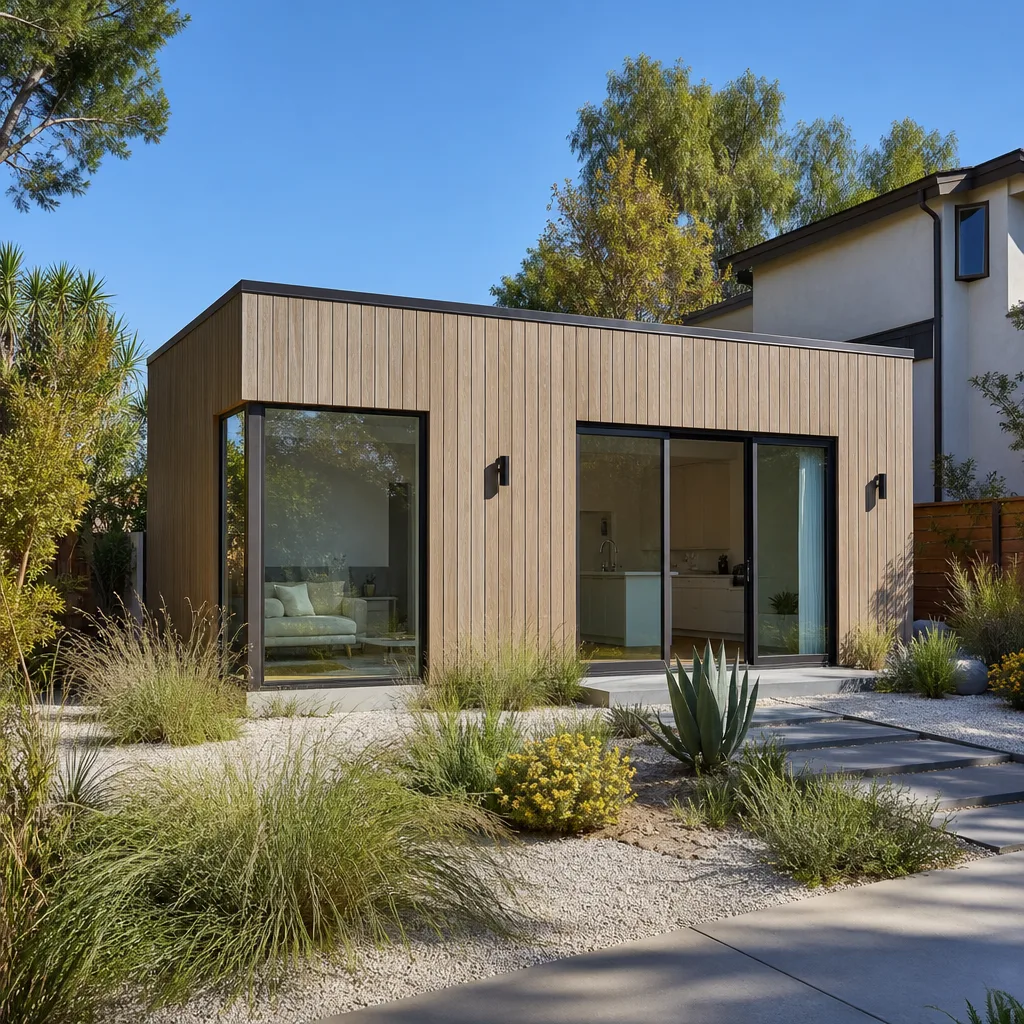
James Hardie siding carries a 30-year limited transferable product warranty, and in Dallas we see properly installed HardiePlank with the ColorPlus factory finish still looking straight and true at 25 years; the weak points are always the flashing and trim joints, not the boards themselves.
Yes, in most cases the failed corner can be removed, the area behind it inspected, fresh flashing installed, and a matching genuine James Hardie corner set in a couple of hours, and the repair is covered under our 365-Day Done Right Promise.
For a typical 400- to 600-square-foot detached ADU, siding and trim installation runs 6 to 10 working days once the walls are framed, sheathed, and inspected; weather delays from spring thunderstorms are the honest wildcard, and we always state the build window in writing before we start.
We keep the common 8-1/4-inch Cedarmill and Smooth HardiePlank, HardiePanel sheets, and standard 5/4 HardieTrim boards staged for Dallas projects, and for non-stock colors or exposures we order directly from the local James Hardie supply yard with a five- to seven-day lead time.
Lodgewick ADU Dallas is an independent service provider and is not affiliated with James Hardie, Abodu, Cover, Dvele, or any manufacturer we mention. We work with their materials because they hold up in Texas weather, period.
Written by Russ Delmar, Owner, Lodgewick ADU Dallas at Lodgewick ADU Dallas, serving Dallas and nearby areas.